Every video editor has experienced the panic of a timeline that just won't cooperate. Specifically, figuring out how to sync clips in final cut pro can sometimes feel like solving a mystery without clues. The "Synchronize Clips" feature is supposed to be a magic button, but when it fails, it halts the entire creative process. Understanding the technical reasons behind these failures is the first step to becoming a more proficient editor.
The implications of these errors are significant, ranging from delayed project deliveries to corrupted project files. When the software encounters incompatible data or ambiguous commands, it protects the project by disabling the sync function. This article aims to demystify these errors and provide actionable solutions derived from expert workflows and technical analysis of the software's architecture.
Common Reasons You Fail at How to Sync Audio and Video Final Cut Pro
The primary culprit often lies in the selection of the media itself. When attempting to execute how to sync audio and video final cut pro workflows, specificity is key. Final Cut Pro requires a one-to-one relationship between the video source and the external audio source for the standard command to function. If you accidentally highlight an extra clip, the software's logic shifts to multicam mode, disabling the standard sync options.
Beyond simple selection errors, the hidden metadata of your files plays a massive role. If your audio file lacks a clear waveform or if the video clip has corrupted audio tracks, the analysis engine cannot find a reference point. This results in the dreaded "sync bar starts loading but never finishes" scenario, leaving you stuck in an endless processing loop that often forces a force-quit of the application.
The Impact of Audio Frequencies on How to Sync Clips in Final Cut Pro
A nuanced technical detail that affects how to sync clips in final cut pro is the sample rate frequency. Video editing standards strictly adhere to 48kHz, but many audio sources, including smartphones and some handheld recorders, utilize 44.1kHz. This discrepancy might seem minor, but it is a mathematical incompatibility that Final Cut Pro struggles to reconcile automatically during the synchronization process.
When you mix these sample rates, the software may fail to sync entirely or, worse, produce a clip that slowly drifts out of sync. This drift is subtle at first but becomes glaringly obvious after a few minutes of playback. The most reliable fix is to transcode your audio assets to 48kHz before importing them. This ensures that all mathematical time references align perfectly within the editing timeline.
Overcoming Hardware Limits in How to Sync Audio and Video Final Cut Pro
Hardware limitations often masquerade as software bugs when you are learning how to sync audio and video final cut pro. Processing long, high-resolution files requires significant RAM and CPU headroom. If you are trying to sync a continuous 4K recording with a high-fidelity WAV file that spans hours, your computer's resources may hit a bottleneck, causing the sync process to stall indefinitely.
Final Cut Pro's sync engine is robust but not invincible. It attempts to load the entire waveform into memory to find matches. When the files are too large, the system runs out of application memory. A strategic approach is to physically chop the files into smaller segments before syncing. This method reduces the memory footprint and allows the software to process the data in manageable bites.
Resolving "Detached Audio" Issues in How to Sync Clips in Final Cut Pro
A specific edge case in how to sync clips in final cut pro involves clips where the audio has been previously modified. If you have used the "Detach Audio" function in a prior sequence or edit, FCP might treat the video component as having no audio reference. Without an embedded audio track to compare against the external file, the synchronization algorithm has no data to align, leading to immediate failure.
innovative Solutions for How to Sync Clips in Final Cut Pro
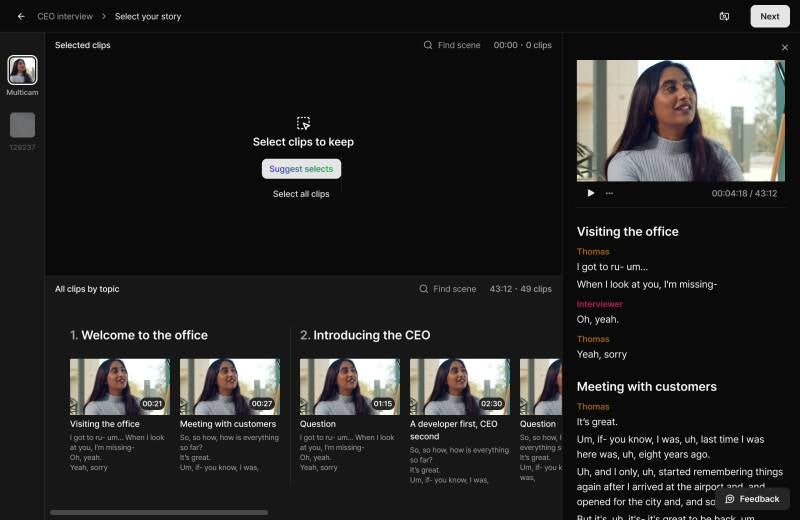
As the landscape of video editing evolves, so do the tools available to solve these persistent problems. Solving how to sync clips in final cut pro issues is now easier with the advent of AI-powered assistants. Cutback Video has introduced tools like "Selects" that fundamentally change the ingest workflow. These tools are designed to bypass the traditional limitations of Non-Linear Editors (NLEs).
Selects acts as a bridge between your raw footage and your final edit. It uses advanced machine learning to listen to the audio content, ignoring the technical discrepancies like sample rate or file format. By understanding the content of the speech, it can align clips with superhuman accuracy. This is particularly useful for multicam setups where traditional waveform matching often produces errors due to microphone bleed or background noise.
Utilizing Cutback to Master How to Sync Audio and Video Final Cut Pro
For those struggling with the complexities of how to sync audio and video final cut pro, adopting a tool like Cutback can be a game-changer. The software automates the tedious synchronization phase, delivering a project file that is ready for creativity. It handles the conversion of sample rates and the alignment of multiple angles in the background, presenting you with a clean slate.
This workflow is especially beneficial for solo creators who do not have the time to debug technical errors. Instead of spending hours reading forums and converting files, you upload your media to Selects, and it hands back a perfectly synced timeline. This integration supports Final Cut Pro directly, ensuring that your transition from raw footage to the editing timeline is smooth and error-free.
Best Practices for Manual How to Sync Clips in Final Cut Pro
If you are committed to the manual path of how to sync clips in final cut pro, establishing a rigid ingest protocol is mandatory. Always rename your clips to reflect their content before importing. This helps in identifying mismatched pairs quickly. Furthermore, verify the integrity of your media files to ensure no corruption has occurred during the transfer from the camera card.
Another best practice is to use a "clapper" or a loud visual cue at the start of every recording. This old-school technique provides a foolproof visual and auditory marker. Even if the software fails to sync automatically, you can manually drag the clips until the spike in the waveform aligns with the visual of the clap. It is a fail-safe that has served the film industry for decades for a reason.
avoiding Multicam Conflicts in How to Sync Audio and Video Final Cut Pro
Finally, to master how to sync audio and video final cut pro, you must distinguish between syncing and multicam creation. If you select two video files and one audio file, FCP assumes you want a multicam clip. Be precise with your selection: one video, one audio. This discipline forces the software to use the correct synchronization engine, avoiding the confusion that leads to greyed-out menu options.
Conclusion
Navigating the technical challenges of video synchronization requires a blend of knowledge and the right tools. From understanding the importance of matching sample rates to managing file sizes, every detail counts towards a successful edit. The frustrations of "sync not working" are often solvable with a few adjustments to your workflow or file preparation.
However, the future of editing lies in automation. Tools like Cutback's Selects demonstrate that AI can handle the heavy lifting, allowing editors to bypass these technical hurdles entirely. By integrating such intelligent assistants into your pipeline, you ensure that issues with synchronization never halt your creative momentum again.
Add comment
Comments